



The New York Jets officially completed their 2026 NFL Draft class on Saturday evening, adding four Day 3 selections to finish with a total of eight new players.
The biggest additions came on Thursday night when the Jets used three first-round picks to select Texas Tech edge rusher David Bailey, Oregon tight end Kenyon Sadiq, and Indiana wide receiver Omar Cooper Jr.
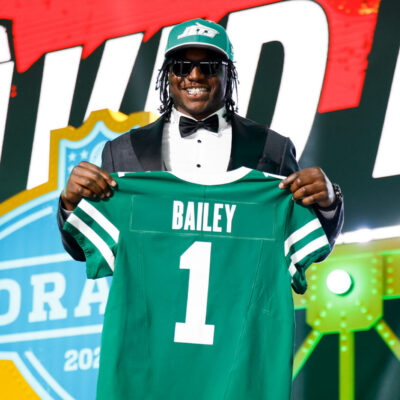
Bailey was chosen second overall, becoming the first defensive player selected in the draft. After leading the FBS with 14.5 sacks during the 2025 season, he arrives in New York as an immediate impact pass rusher for a defense that struggled to consistently pressure opposing quarterbacks last year.
Speaking after hearing his name called, Bailey expressed his excitement about joining the organization.
“I’m grateful to all the fans who came out here tonight. I just want to be a sponge, soak up everything and make me the best player I can be to help this organization. I think they want to go in the right direction, and I’m just ready to work.”
Holding the 16th overall selection, many analysts expected the Jets to target a pass catcher, but few projected them to select Sadiq. Widely regarded as the top tight end prospect in the draft, Sadiq combined elite production with exceptional athletic traits. He recorded 51 receptions, 560 receiving yards, and eight touchdowns in 2025 while also posting eye-catching testing numbers, including a 4.39-second 40-yard dash and a remarkable 43.5-inch vertical jump. Those attributes elevated him into discussions alongside the draft’s best receiving threats and ultimately convinced the Jets to add the dynamic playmaker.
“David Bailey said it already,” Sadiq told reporters after his selection. “This organization is trending in the right direction. And I’m just a piece that can help and I’m ready to help. Whatever the team needs me to do, I’m going to do it.”
The Jets were not finished on Day 1. Holding the 30th overall pick after a trade back into the first round, New York sent the 33rd overall selection and a fifth-round pick (No. 179) to the San Francisco 49ers in order to draft Omar Cooper Jr.
Cooper had frequently been linked to the Jets throughout the pre-draft process and was considered a realistic option even at No. 16 overall. His addition gives New York another explosive weapon in the passing game alongside Sadiq.
The Indiana standout led the National Champion Hoosiers in receiving yards (937), receptions (69), and touchdowns (13), serving as the favorite target of Heisman Trophy winner Fernando Mendoza. His ability to line up both on the outside and in the slot gives the Jets valuable versatility. Cooper also became the first wide receiver selected by the Jets in the first round since Garrett Wilson in 2022, which was also the last draft in which New York made three first-round selections.
“My strength is my yards after the catch,” Cooper told reporters. “I have really good, strong hands, and I also can run any route when given the opportunity. And I’m a good run blocker as well.”
Cooper became the first Indiana player drafted by the Jets since 1974, but he would not be the last Hoosier selected by New York during this draft. After moving back from the 44th overall pick, the Jets used the 50th selection in the second round to draft cornerback D’Angelo Ponds, one of the premier defensive backs in college football.
The comparison often made for Ponds is current Jets head coach Aaron Glenn. Despite being undersized for the position, Ponds plays with relentless intensity and competitiveness. During Indiana’s National Championship campaign, he consistently changed games with his playmaking ability, including a pick-six on the opening snap of the College Football Playoff semifinal. Few coaches are better equipped to guide his development than Glenn, who enjoyed a highly successful NFL career at the same position.
Day 3 began with another pair of additions. The Jets selected Florida State defensive tackle Darrell Jackson Jr. with the 103rd overall pick before trading up to No. 110 overall to draft Clemson quarterback Cade Klubnik.
Jackson brings impressive size and power to the defensive front at 6-foot-5 and 315 pounds. He projects as a physical presence against the run while also possessing the potential to develop into a productive interior pass rusher.
Klubnik completed 66 percent of his passes during the 2025 season, throwing for 2,943 yards with 16 touchdowns and six interceptions. Although Clemson endured a difficult start to the year, the Tigers rallied late to finish the regular season with a 7-5 record. In New York, he will have the opportunity to learn behind veteran quarterback Geno Smith while continuing to refine his game.
“Really faced a lot of adversity this past year,” Klubnik said. “For me, I figured out how to take a team that’s not winning and transform and go win games to finish with four straight wins at the end of the year. So, I’m all about pushing the guys around me. And I’m a winner and I’m a competitor, and I hate to lose. So, if we’re not winning – we’re going to find a way to win.”
The Jets rounded out their draft class by adding depth to both the offensive line and secondary. With their final two selections, they drafted Miami guard Anez Cooper and Kansas State safety VJ Payne.
Cooper was a fixture on Miami’s offensive line, making 45 starts at right guard and earning All-ACC honors in each of the last three seasons. Payne started 42 games during his collegiate career at Kansas State and finished with 196 tackles, three interceptions, and four forced fumbles.
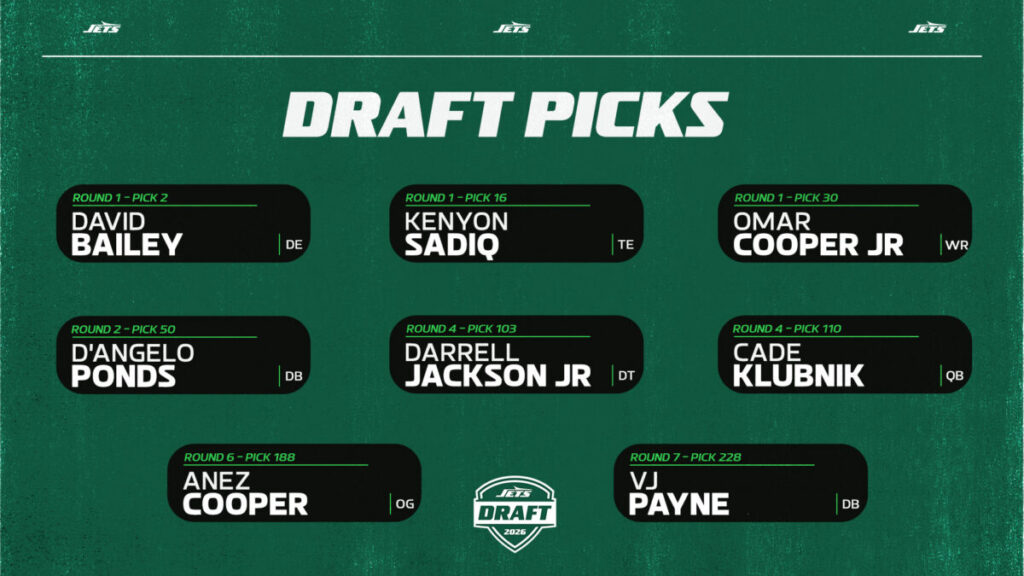
Overall, General Manager Darren Mougey completed four trades during draft weekend. Three of those deals were used to move up the board, allowing the Jets to aggressively target players they valued highly. In the end, New York utilized only two of its originally assigned draft selections.
Several themes stood out throughout the Jets’ 2026 draft class. Winning pedigree was a clear priority, highlighted by the selection of two National Champions from Indiana. Speed was another defining characteristic, with several selections boasting impressive athletic testing numbers. From top to bottom, the Jets focused on adding explosive, competitive players from successful college programs as they continue building toward the future.