



2025 Season Results: 3–14 (4th in AFC East) — Missed Playoffs
Introduction
The 2025 season marked the beginning of a new era for the New York Jets following the abrupt end of the Joe Douglas-led front office, the coaching tenure of Robert Saleh/Jeff Ulbrich, and the Aaron Rodgers quarterback experiment. In their place, the organization appointed longtime Denver Broncos scout Darren Mougey as General Manager and former Jets safety—and Detroit Lions defensive coordinator—Aaron Glenn as Head Coach.
The Jets quickly assembled a new coaching staff, featuring first-time playcaller Tanner Engstrand as Offensive Coordinator, former NFL head coach Steve Wilks as Defensive Coordinator, and Chris Banjo, who had only two seasons between his playing career and his role as Special Teams Coordinator.
Describing expectations for this team as “muted” would be an understatement. The Jets once again entered a season defined by transition, carrying the league’s longest active playoff drought—a distinction that had now surpassed every other franchise in North America.
Organizationally, this was another reset in structure. The Joe Douglas era began with hopes of restoring a traditional GM-led hierarchy, where football operations were clearly defined and the head coach reported upward. However, after missing on a No. 2 overall quarterback selection while still finding some success in the 2022 draft class, the organization effectively ceded control of the roster direction during the Aaron Rodgers era.
That experiment ultimately collapsed, and as of last year, discussion of Rodgers as a Jet was effectively closed out.
In response, the Jets pivoted toward a coach-first identity, hiring Aaron Glenn. A respected former player and well-regarded defensive mind in Detroit, Glenn brought leadership traits and player buy-in, even if his units were not consistently top-five statistically during his tenure.
The Jets hired Glenn before finalizing their GM, and it was widely speculated that he influenced the hiring process. Early indications pointed toward Washington assistant GM Lance Newmark, due in part to his Detroit connections with Glenn, but the Jets ultimately selected Broncos assistant GM Darren Mougey—an executive with over a decade of scouting experience and a long-rising profile within league circles.
Once installed, Mougey immediately began reshaping the roster, moving on from Rodgers and signing Justin Fields to a heavily debated two-year contract before eventually pivoting away from him. The roster underwent multiple layers of reshaping through free agency and early-season adjustments.
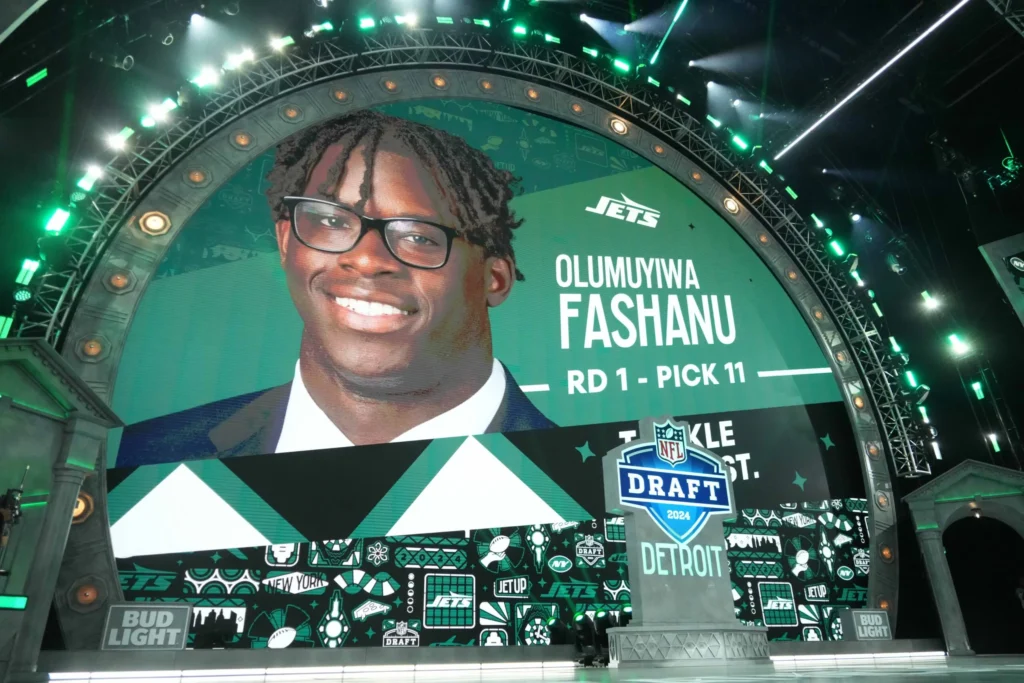
The 2025 draft class showed mixed early returns. First-round offensive lineman Olu Fashanu earned PFWA All-Rookie honors, and tight end Mason Taylor delivered steady production in a difficult offensive environment. However, expectations were higher for wide receiver Arian Smith and defensive additions Kiko Mauigoa and EDGE Tyler Baron, particularly given the draft capital used to acquire them.
Still, most fans understood the reality: this was not a one-year fix. It was another multi-year rebuild layered on top of years of instability.
Season Recap: “Instant Coffee”
Aaron Glenn entered his first season in New York with confidence and a clear cultural message. At the 2025 NFL Combine, he stated, “We’re here to win now”—a phrase that would quickly become symbolic of the tension between expectations and reality.
With Rodgers gone, the Jets attempted to solve the Justin Fields question at quarterback. Fields represented a volatile but inexpensive upside swing—capable of both high-level flashes and prolonged inconsistency. While not a perfect solution, the Jets had limited alternatives in free agency or the draft.
Three weeks into the season, however, the results were already alarming. After a series of lopsided losses, including a 30–10 defeat to Buffalo, Glenn criticized media and fans for what he called an “instant coffee mentality,” stating:
“This is an instant coffee league. From the media to the fans, everybody expects when you just start, okay, we’re going to the Super Bowl.”
The response from the fanbase was immediate and overwhelmingly critical, largely because the statement felt disconnected from actual expectations. Most Jets fans were not demanding Super Bowl contention—they were reacting to historically poor performance, lack of competitiveness, and repeated early-season collapses.
The broader frustration centered less on championship expectations and more on basic competitiveness. A three-win season, repeated blowouts, and games that appeared to slip away without resistance created a narrative that went far beyond impatience.
There is no need to overstate the failures of the season: most things simply did not work. The offense stagnated, the defense struggled to generate impact plays, and at multiple points the team appeared to lose structure entirely.

By midseason, even the coaching staff appeared to recognize the situation was spiraling. What followed was a collapse that ended in a 3–14 record, including a late-season stretch defined by heavy scoring deficits and minimal resistance.
One of the few statistical anomalies was the Jets finishing the season without recording a single defensive interception. Combined with repeated blowout losses, the season ended with morale at a low point.
The Jets closed the year on a five-game losing streak, being outscored by a massive margin in the process. What had been framed as a cultural reset quickly shifted into another evaluation cycle.
2026 Offseason: Holding Onto the Rope
Following the collapse, Glenn moved aggressively to reshape the roster and coaching structure. Defensive coordinator Steve Wilks was dismissed, a move widely expected after a historically poor defensive showing.
The roster itself underwent significant restructuring. The Jets moved veteran and high-value players in exchange for draft capital, including Michael Carter II, Sauce Gardner, and Quinnen Williams. These moves signaled a shift toward a longer-term rebuild, prioritizing flexibility and future assets over short-term competitiveness.
The decision to trade Sauce Gardner was particularly notable, given his status and recent extension, but reflected a broader organizational belief that the roster could not be fixed without a full reset of resources. Quinnen Williams’ departure similarly marked the end of a foundational defensive era.
Shortly afterward, Glenn addressed fans directly:
“For the fans, listen, it’s going to be a tough road, we knew that, but, man, the thing is, we know exactly what we’re doing. We have a plan. Just don’t let go of the rope.”
However, within weeks, further staff changes followed, including the firing of offensive coordinator Tanner Engstrand after just one season.
The Jets quickly pivoted again in staffing, hiring Brian Duker as defensive coordinator and Frank Reich as offensive coordinator. The structure suggested a hybrid model in which Glenn would take a hands-on defensive role while Reich managed offensive responsibilities.
The plan also indicated a schematic shift from a 4–3 defense to a 3–4 system, reflecting a broader philosophical reset.
Trades
- Jets acquire QB Geno Smith and a 7th-round pick from the Raiders in exchange for a 6th-round pick
- Jets trade QB Justin Fields to the Chiefs for a conditional 7th-round pick (2027)
- Jets acquire S Minkah Fitzpatrick from the Dolphins for a 7th-round pick
- Jets trade EDGE Jermaine Johnson to the Titans for DT T’Vondre Sweat
Overall, these moves reflect a clear attempt to stabilize both the quarterback position and defensive structure.
The quarterback swap from Fields to Geno Smith represents a shift from volatility to steadiness. While Smith lacks high-end upside at this stage of his career, he provides structure and reliability at a position where the Jets had struggled to find consistency.
The acquisition of Minkah Fitzpatrick similarly adds experience and versatility to the secondary, with expectations that he will be deployed in a deeper free safety role to maximize his strengths.
The Jermaine Johnson trade for T’Vondre Sweat represents a schematic alignment move, with both players potentially better suited to their new systems. Sweat offers immediate value as a run-stopping presence at nose tackle within a 3–4 front.
Taken together, the Jets’ approach appears focused on marginal gains, structural clarity, and roster fit rather than star-chasing—an attempt to stabilize a franchise still searching for long-term identity.
Other Articles

New York Jets’ 2026 NFL Draft Picks: Full List, Analysis
ANTH COOK NAMED NEW YORK JETS 2025 INTERNATIONAL FAN OF THE YEAR!